
The AiLTITUDE Solution
Custom AI activation on top of a standardized AI infrastructure.
-
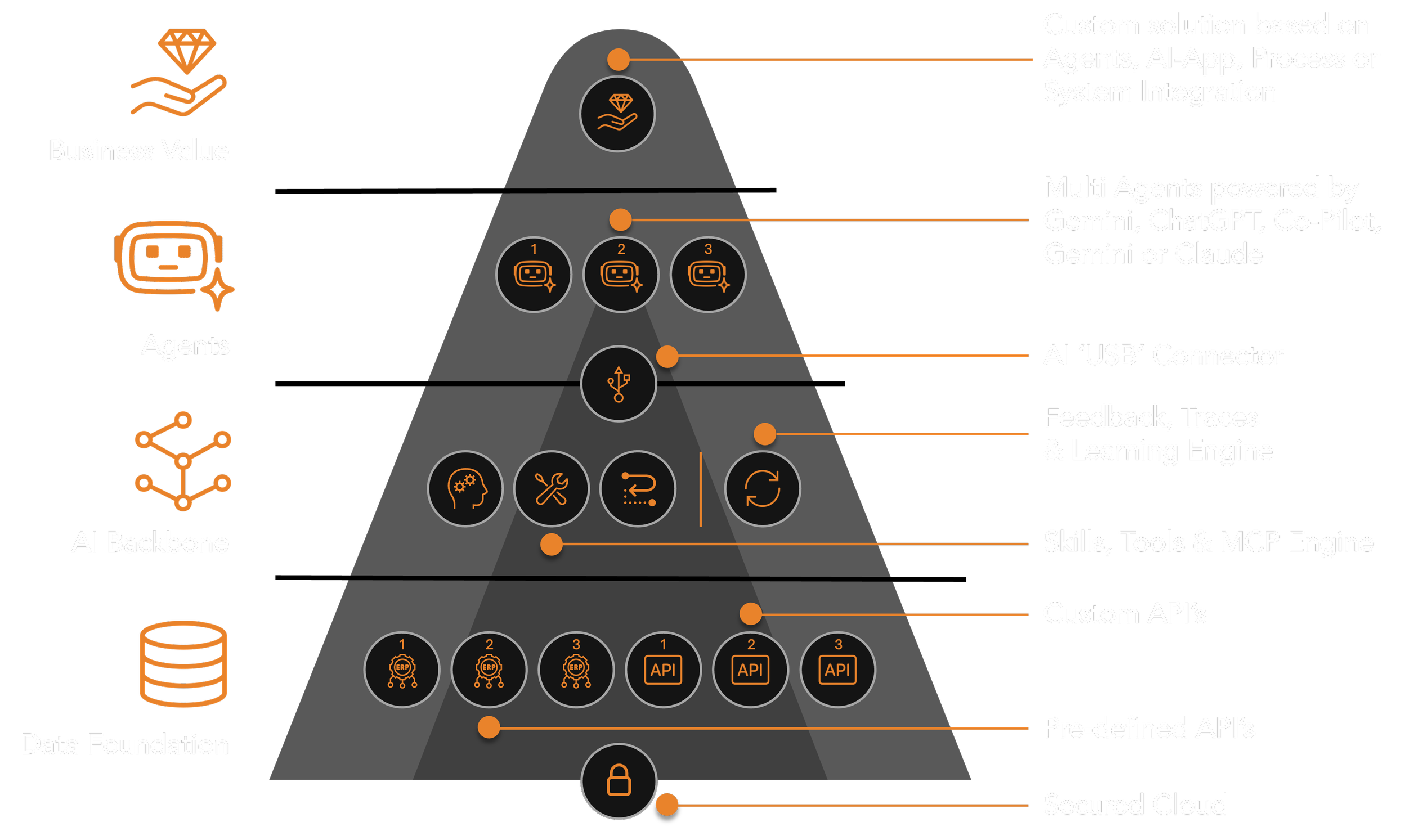
The Ailtitude Solution combines two layers.
At the top: fully custom business configuration and agent orchestration.
At the core: a standardized AI infrastructure product that makes enterprise data reliably usable by AI.
The infrastructure remains stable. The business layer adapts per client.
Custom Activation Layer
The upper two layers of the Ailtitude Solution are fully tailored to the organization. It translates strategic objectives into configured AI capabilities, using established LLM ecosystems. These layers adapts to each client, while the underlying infrastructure remains consistent and standardized.

Business Value
Every implementation starts with a defined strategic objective. Business Value is always customer-specific. It defines the operational goal that AI must support.
-
Each organization has distinct processes, constraints, and ambitions. Within the Ailtitude Solution, Business Value is translated into a concrete AI activation strategy. This can involve operational acceleration, structural efficiency improvements, decision-support capabilities, or new digital services.
This layer is fully custom. It determines which capabilities must be activated and which data domains must be exposed to AI. It defines direction, scope, and measurable impact.
Business Value does not belong to the Ailtitude product core. It is the strategic configuration that sits on top of it.

Agents
Agents are configured using existing LLM ecosystems such as ChatGPT, Claude, Copilot or Gemini. These agents operate outside the Ailtitude core environment.
-
Within each implementation, agents are tailored to the client’s business processes. They may automate workflows, support users, coordinate tasks, or perform reasoning operations.
The agents themselves are not proprietary Ailtitude models. They are configured on top of leading LLM platforms. The customization lies in how these agents are instructed, constrained, and connected to structured enterprise data.
This configuration layer adapts per client and per use case. It remains flexible and LLM-independent.
The stability of these agents depends entirely on the structured data interface provided by the Ailtitude infrastructure.
The Ailtitude Atlas
From this point downward, the Solution becomes a defined and repeatable product architecture.
AI Backbone
The structured intelligence layer that makes enterprise data AI-readable.
The AI Backbone is a fixed component of the Ailtitude product. It translates raw enterprise data into structured, governed knowledge that AI systems can reliably interpret.
-
The AI Backbone consists of the Model Context Protocol layer (MCP), structured Tools, and defined Skills. Together, these components control how AI models access, interpret, and use enterprise data.
This layer establishes semantic clarity. It defines what data represents, how it may be used, and which operational boundaries apply. It prevents ambiguity before AI reasoning begins.
The Backbone ensures that AI interacts with structured meaning rather than fragmented datasets. It guides model interpretation so that reasoning remains within defined context and policy boundaries.
This is the core engineering discipline of Ailtitude: making data structurally understandable for AI.
AiLTITUDE Atlas is LLM independent

Data Foundation
Direct connection to source systems.
The Data Foundation connects the Ailtitude infrastructure directly to enterprise source systems such as databases, ERP environments and secure endpoints.
-
This layer integrates at the origin of operational data. It connects to structured databases, ERP systems such as AFAS, and domain-specific APIs.
Each endpoint is mapped into a controlled representation. Data semantics are preserved. Ownership remains clear. Governance policies remain enforceable.
The Data Foundation ensures that the AI Backbone works with accurate, authoritative source data. It establishes the structural base on which AI can operate.

The AI ‘USB’ Connector
A standardized AI interface layer.
The combination of Data Foundation and AI Backbone forms a universal connection interface, comparable to a USB connector for AI.
-
This connector standardizes how AI systems interact with enterprise data. It defines structure, context, and permissions before any agent is activated.
Through this interface, multiple agents, across different LLM platforms, can safely access structured knowledge. The connector remains stable while agents and use cases evolve.
The result is modular scalability. Business applications can expand without redesigning the infrastructure layer.

Secured Cloud
Our Secured Cloud is the foundation of every AI solution we deliver. Data, models and processes operate within a strictly isolated environment featuring end-to-end encryption, separated environments (development, testing, production) and granular, role-based access control.
-
We apply zero-trust architecture principles, comprehensive logging, and full traceability of actions and data flows. Data remains within agreed geographic regions and is never used for model training without explicit consent.
The result: maximum control, minimized risk, and an infrastructure aligned with applicable security and privacy standards.
Operational Impact
A standardized AI infrastructure becomes valuable when it is applied to real operational challenges. Once enterprise data is structured through the Ailtitude Backbone and exposed via the AI connector, organizations gain the ability to activate AI across concrete workflows.
-
With the AI USB connector in place, enterprise data is no longer isolated within systems. It becomes accessible, interpretable, and actionable for configured AI agents.
This enables practical applications such as:
AI-assisted operational decision making based on live ERP data.
Automated internal workflows grounded in authoritative source systems.
Context-aware digital assistants connected to structured enterprise knowledge.
Cross-system reasoning without duplicating data.
Because the underlying infrastructure is structured and governed, each new application builds on the same foundation. New use cases do not require rebuilding the architecture. They extend it.
The result is cumulative capability. Each implementation strengthens the organization’s AI maturity.
To understand how this translates into concrete deployments, explore the use cases below.